Start with what the record cannot show
Imagine two hypothetical auditors opening the same event register. They agree on every visible entry and reproduce the same summary. One asks what the register contains. The other asks what happened to everyone the investigation was intended to describe, including anyone without a usable record. Their agreement settles the first question only. A calculation can be flawless while the proposed interpretation extends beyond the observations that entered it. The scientific task is to identify that extension before deciding whether a reassuring statement is justified.
For this imagined audit, the absence of a row admits several explanations. Perhaps no event occurred, perhaps an observation was never made, or perhaps a recorded observation did not satisfy the analysis rule. Those possibilities would need different evidence to distinguish them. Treating every blank as an uneventful experience would silently choose one explanation. Treating every blank as an adverse experience would choose another. Neither conclusion follows from the blank itself, and uncertainty about its meaning is not evidence that a particular error actually occurred.
A defensible reassurance claim therefore needs a stated object: reassurance about which outcome, among which people, during which period? Its strength also depends on whether the observation process could distinguish the alternatives relevant to that claim. If two very different underlying experiences could produce the same available register, the register alone cannot select between them. This article asks how to recognize that limit while retaining the information the recorded observations genuinely supply.
Who belongs in the scientific question
STEP-1/3 enrolled adults without diabetes, with BMI ≥30 or ≥27 plus a weight-related condition; STEP-2 required type 2 diabetes and BMI ≥27. The selected arms compared weekly subcutaneous semaglutide 2.4 mg with placebo over 68 weeks; STEP-3 added intensive behavioral therapy.[2]
Consider a hypothetical investigation that admits only people whose records meet a specified eligibility rule, while a reader wants an answer about a broader community. The rule creates a boundary around the evidence. Crossing that boundary requires an argument about why the comparison should remain informative outside it. It does not logically establish either success or failure among people who were never represented. An absence of direct information is different from direct evidence of an absent effect.
That argument must distinguish three objects: the people studied, the intervention being compared, and the people to whom the result might later be applied. Holding the intervention's name constant would not by itself make the populations interchangeable. Conversely, a difference between populations would not automatically invalidate every possible comparison. The relevant question is whether the differences matter for the particular outcome and contrast under consideration. A claim of transfer should specify which differences it assumes are immaterial and what evidence supports that assumption.
In a hypothetical extension, investigators might seek observations from an additional group or justify a model connecting groups. Giving existing observations different weights could address representation only where suitable observations exist; weights cannot manufacture experience for an entirely unrepresented category. This separates a statistical adjustment from an evidentiary bridge. Before extending a conclusion, ask which part of that bridge is observed and which part remains assumed.
Count people before interpreting the percentage
Post hoc percentages were trial-adjusted. On-treatment events required dosing within the previous 49 days; descriptive weight analysis required week-68 measurements and dosing within the previous two weeks.[1]
Reading the event measure
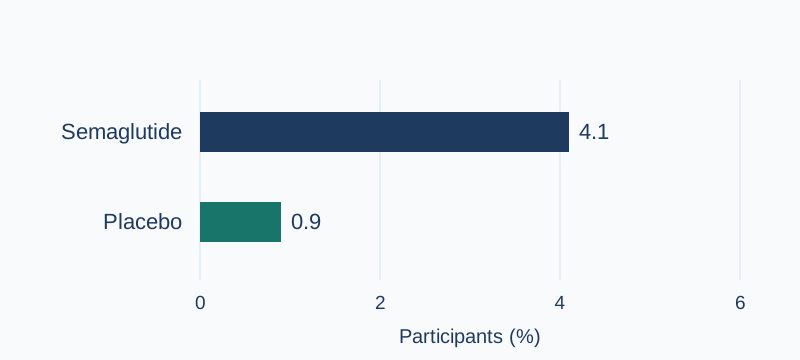
| Arm | Participants (%) |
|---|---|
| Semaglutide | 4.1 |
| Placebo | 0.9 |
Consider an entirely hypothetical register containing three people, labeled A, B and C. A has several separate event entries, B has one, and C has an explicitly completed record showing none. Counting entries would describe event frequency. Marking whether each person had any qualifying event would describe people affected: additional entries for A would not change A's yes-or-no indicator. Neither summary substitutes for the other. To interpret either, the analyst must first specify the unit being counted and the rule for qualifying.
A separate distinction concerns classification. Imagine a hypothetical register with two qualifying rules, labeled A and B. An entry can meet A, B, both or neither unless the definitions rule out one of those combinations. Adding the category counts could therefore count an entry twice. Likewise, a percentage restricted to A cannot silently become a percentage for every entry, and its complement identifies entries outside A rather than entries satisfying no other rule. Check definitions before interpreting either count.
Adjustment adds another operation. In a hypothetical collection of datasets, a summary constructed by weighting their separate percentages need not equal a single fraction formed from all their counts. Recovering it would require the component summaries and the weighting rule. A displayed count can still be informative without being sufficient to reconstruct the displayed adjusted percentage. Nor would agreement between a crude calculation and an adjusted one demonstrate that their methods were identical; different calculations can coincide. The useful audit checks the recipe, rather than guessing it from a number that happens to look plausible.
Ask which observations qualify
Take a hypothetical rule accepting observations through May 10. Two otherwise identical fictional entries are dated May 10 and May 11. One qualifies and the other does not. That difference is a consequence of the rule; it does not establish an abrupt biological change between the dates. A record-selection boundary defines what enters a calculation. Interpreting it as the exact beginning or end of an underlying experience would require a separate evidentiary argument.
The definitions stated earlier should therefore be read as instructions for assembling evidence. Different outcomes may justify different instructions. An event record might answer whether something was documented during an interval, whereas a measurement might answer a question about a specified occasion. In a hypothetical analysis using both, a person could supply an eligible record for one outcome but not the other. Equal-looking percentages or matching column headings would not establish that the underlying sets of observations were the same.
It helps to distinguish an observed zero, a recorded absence, and no eligible record. A numerical measurement of zero has a value and a measurement context. A completed event assessment recording no occurrence answers its defined question. An unavailable or ineligible assessment supplies neither conclusion. Keeping these states separate prevents a data-cleaning decision from becoming an unspoken scientific assertion. When preparing to compare records over time, a useful reading task is to preserve dates, outcome definitions and eligibility reasons alongside values. That makes it possible to ask whether an apparent change describes the measured outcome or a change in which observations were admitted.
An absent outcome is an unresolved value
Now imagine a dataset with observed outcomes and some unresolved outcomes. Construct two hypothetical completions while leaving every observed value untouched. In one completion, the unresolved values resemble those available. In the other, they differ systematically. Both completions fit the visible observations because those observations have not changed. Yet they can support different summaries of the intended whole. The observed part alone cannot decide which completion is closer to reality.
This is an identification problem before it is a calculation problem. Additional decimal places would make the observed summary more precise as a report of the recorded data, but would not identify the unobserved values. A larger collection of similarly selected records could also leave the same conceptual gap. The missing ingredient is information that connects the available outcomes to the unavailable ones, or an explicit assumption supplying that connection. An assumption may be defensible without being directly verified by the outcomes it substitutes for.
In this hypothetical setting, the reason an outcome is unavailable would matter if it helped assess that connection. A reason label alone would not necessarily reveal the missing value. One could ask how far unresolved values would have to depart from the available pattern before a conclusion changed, and whether independent evidence made such departures plausible. This sensitivity question avoids pretending that a completed dataset has been observed. Filling a blank through a model creates an analytical value, not a newly measured one; any resulting uncertainty assessment should acknowledge the assumptions used to create it. These alternatives illustrate possible interpretations of incomplete evidence, without establishing a missing fraction or a direction of bias in the actual records.
Choose the target before choosing the method
Consider two hypothetical scientific targets. The first concerns an outcome under continued exposure to an intervention. The second concerns outcomes following initial assignment, regardless of subsequent decisions. These are different questions even if the same people and intervention appear in both. For the first, the analyst would need to explain what continued exposure means and how outcomes under that condition could be learned. For the second, later changes would remain part of the experience the question seeks to describe.
An estimand is a precise description of such a target. Naming the outcome is only part of the description: the relevant population, comparison, time and treatment of later events also matter. Choosing a convenient subset of complete records does not automatically identify any particular target. In a hypothetical randomized investigation, restricting analysis to people who later meet an observation condition could create groups differing in ways the initial assignment did not determine. One would need to justify the resulting comparison rather than borrowing the force of randomization for a new grouping.
A broader target could require continued outcome collection after changes in exposure, clear records of those changes, and assumptions for information still unavailable. More complete follow-up would help with observation, but it would not by itself turn a description into the answer to every causal question. Before selecting a statistical method, write down what hypothetical experience the method is intended to represent. Read the companion outcome analysis with that same question in mind: which target would make a comparison meaningful, and what information would be needed to identify it?
Trace decisions as well as funding
Novo Nordisk funded trials and writing; both statistical analysts were employee-shareholders.[1]
A disclosure supplies information about interests and roles; it does not perform a statistical audit. Neither accepting an estimate because its authors disclose their interests nor rejecting it solely on that basis tests the calculation. The more useful response is to identify decisions that could be inspected. For the distinctions developed here, those include the definition of a qualifying record, the handling of repeat entries, the weighting operation and the treatment of unavailable outcomes.
A reproducible account would connect those decisions to their consequences. An independent analyst should be able to start from appropriately accessible records, apply the stated transformations and explain why each observation enters or leaves each calculation. A final number alone cannot provide that trail. When access is restricted, the audit should say which steps remain unverified rather than replacing access with confidence in a person's institutional affiliation. This is a proposed standard of inspection, not a claim that the underlying files have been obtained.
Reproduction and judgment also need separate conclusions. Two analysts applying the same fully specified rule should be able to compare their results and locate implementation differences. If they agree, that supports faithful execution of the rule. They might still disagree about whether the rule answers the most useful question, or about which assumption is defensible for an unresolved outcome. Such disagreement calls for a comparison of targets and assumptions. It does not, by itself, show arithmetic misconduct, and arithmetic agreement does not establish independence or settle the adequacy of the scientific interpretation.
Specify what a reanalysis would test
A proposed reanalysis could begin by freezing a version of the source records, defining the target in writing and preserving the calculation rules. No such reanalysis is claimed here. In this hypothetical exercise, the first task would be exact reproduction under unchanged conditions. A disagreement at that stage would prompt checks of data versions, parsing, classifications and transformations before any difference was interpreted as a substantive scientific finding.
The next task would hold the records and target fixed while varying one stated assumption about unavailable outcomes. Each alternative would need a rationale, rather than being chosen because it produced a preferred answer. Recording the changes separately would show which assumption drove which result. A further exercise could vary combinations of assumptions if their joint consequences mattered; stability under isolated changes would not guarantee stability when the changes were combined.
Three findings would deserve different names. A coding discrepancy means the implementation fails to express the specified procedure. A target mismatch means the procedure addresses a different question from the claim made for it. Sensitivity means a conclusion changes under a specified alternative assumption, even when both implementations are correct. Repeating a calculation under an unchanged assumption tests none of that assumption's adequacy. A useful audit would report the smallest justified change that alters the interpretation, along with evidence for or against that change. It would also identify conclusions that remain stable across the examined alternatives, without extending that stability to possibilities the exercise never tested.
A group summary is not a personal guarantee
A hypothetical group summary can be compatible with different distributions of individual probabilities. One possible model assigns everyone the same probability; another assigns different probabilities whose aggregate is identical. The shared summary cannot choose between those models. Learning which model better represents individuals would require additional information and predictions checked against outcomes, rather than a more confident reading of the group percentage.
Prediction also needs a declared purpose. A probability might be assessed for calibration across comparable predictions, yet still provide limited discrimination between individuals. A decision adds another layer: it depends on which outcomes matter to the person and how competing possibilities are weighed. None of those judgments can be recovered from an aggregate frequency alone. Describing uncertainty accurately is therefore part of the reasoning, not a promise that uncertainty can be removed.
Use the molecule profile to organize questions about terminology and source scope, then read a provider document separately to inspect its dated claims. These are distinct reading tasks. Linking them does not transfer a clinical comparison to the named service or establish a personal forecast. A provider document would require evidence appropriate to its own claim; an individual prediction would require evidence appropriate to prediction.
Keep the clinical boundary visible
Wegovy delays gastric emptying and is not recommended in severe gastroparesis. Contraindications include personal or family medullary thyroid carcinoma history, multiple endocrine neoplasia type 2, and prior serious semaglutide or ingredient hypersensitivity. Persistent or severe abdominal pain warrants prompt assessment; gastrointestinal dehydration can injure kidneys.[3]
Compounded drugs lack FDA approval.[4]
The clinical information above and the methodological analysis answer different kinds of questions. This discussion cannot replace an individual clinical assessment or determine a provider's compliance. Its purpose is to make the assumptions behind an interpretation visible. It supplies no personal treatment decision and offers no instruction for changing a medication or managing a symptom.
Reader questions
Can accurate calculations still answer the wrong question?
Yes. Imagine that the target is everyone initially eligible, but the calculation uses only records satisfying a later condition. Perfect arithmetic would summarize that selected set. Extending the answer requires a justified connection between the set and the target. The mismatch concerns what the result means, not whether the analyst divided or weighted the available values correctly.
Does a disclosed sponsor role settle whether an analysis is trustworthy?
No. Disclosure helps identify what deserves scrutiny, but trust in an analytical claim also depends on its traceable calculations and defensible assumptions. Reproducing a result checks execution under specified rules. Examining alternative assumptions checks a different issue. Neither exercise alone settles every interpretation, and a sponsor disclosure is a substitute for neither.
Why does a group percentage leave my own outcome uncertain?
An aggregate can fit several patterns of individual variation. Choosing a personal prediction from those patterns requires additional information and evidence that the prediction works for its intended use. Even a well-assessed probability describes uncertainty rather than guaranteeing an outcome. The group summary supplies a starting constraint; it does not uniquely determine the individual's future.
Editorial assessment
The strongest interpretation is one whose target, observations and assumptions fit together. An accurate description of a recorded set remains useful even when a broader question is unresolved. Its value is diminished when that boundary disappears inside a claim of reassurance. A careful evaluation should ask which conclusions follow directly from the defined observations, which depend on an assumption about unavailable outcomes, and which require a different kind of evidence altogether. Reproduction can establish that a method was executed consistently; sensitivity analysis can show how an interpretation responds to specified alternatives. Neither converts an unmeasured outcome into an observation or an aggregate into a personal guarantee. The practical scientific standard is to make those transitions inspectable. A reader should be able to identify the extra premise needed for the next claim, rather than being asked to accept a stronger conclusion merely because the underlying arithmetic is precise.
Limits of this analysis
This is an evidence-reading analysis, not an independent reanalysis of participant records or a clinical review. Hypothetical examples explain logical distinctions and do not reconstruct unreported study results. The discussion cannot establish individual outcomes, assess a particular provider's compliance or resolve assumptions that would require additional observations.
References
- Wharton (2022) · Diabetes Obes MetabSource checked 2026-10-28
- Kushner (2020) · ObesitySource checked 2026-10-28
- WEGOVY · NLMSource checked 2026-10-27
- FDA GLP-1 · FDASource checked 2026-10-27
About this publication · Commercial disclosure · Request a correction