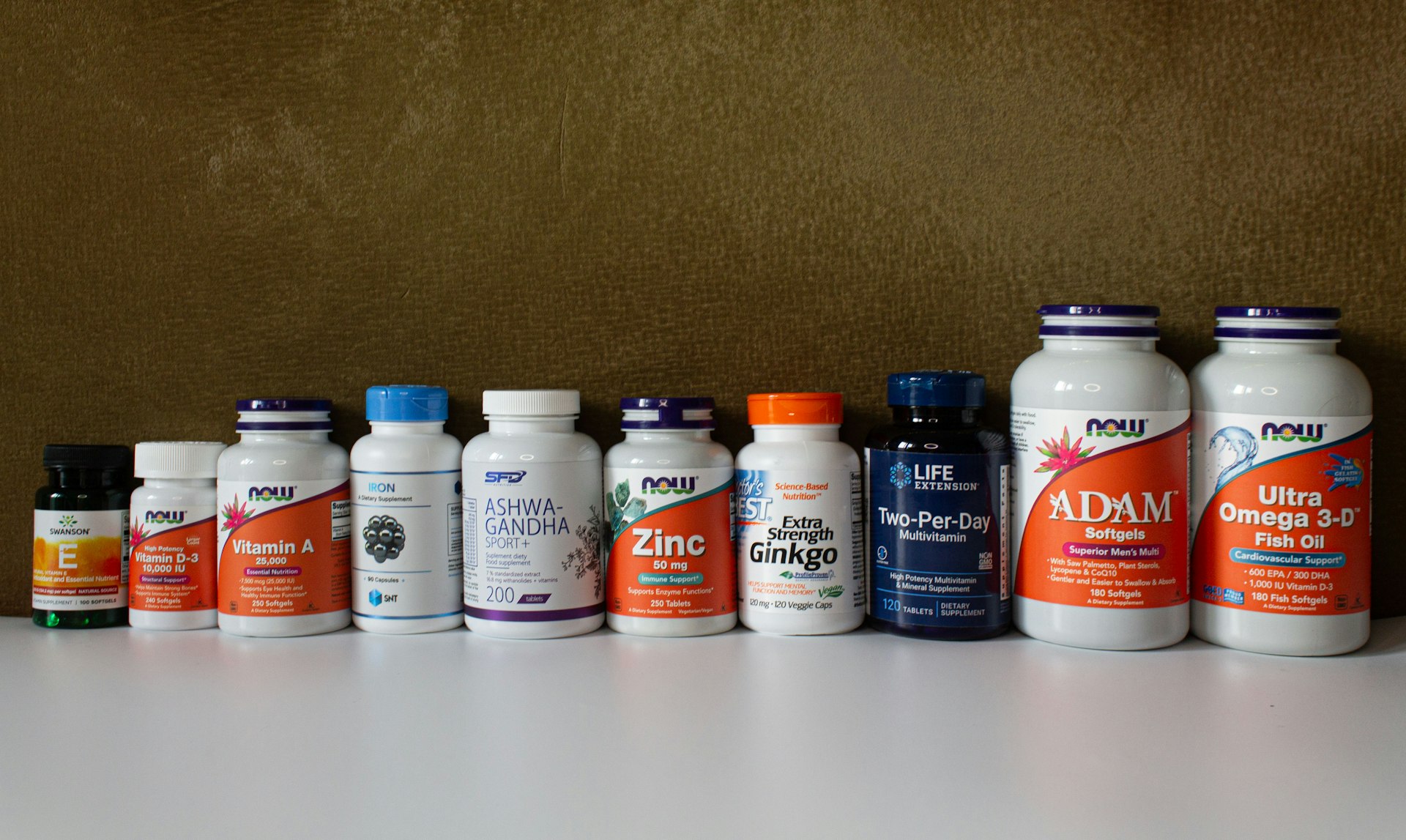
Best GLP-1 Supplements 2026: Every Product We've Tested, Ranked
We read the labels, pulled the trials the marketing cites, and checked the doses against the studies. The scores run from 8.4 down to 1.0, and the honest answer to 'which supplement works like Ozempic' is that none of them do.
Quick Answer
Our #1 supplement pick is CoreAge Rx GLP-1 Support (8.4/10) — a delayed-release Akkermansia probiotic with the prebiotic substrate it actually needs, third-party tested, cold-shipped, from $23.83 a bottle. It is the only product in this category that gets the delivery, the handling and the contraindications right, and it says plainly that it is not a prescription GLP-1. Our #1 overall recommendation is still supervised treatment, and our top-rated provider is CoreAge Rx (9.9/10), which dispenses compounded semaglutide and tirzepatide through licensed 503A pharmacies from $99/month. Among other supplements, Nature Made (8.2) is the best buy for basic nutrition cover and SoWell (7.1) is best if convenience is what stops you eating enough protein. Avoid GLP-1 drops (1.0) and GLP-1 patches (2.1) entirely.
#1 Overall: CoreAge Rx — Because the Category's Best Answer Isn't a Supplement
We have reviewed fifteen over-the-counter GLP-1 products for this ranking. The most useful thing we can tell you is that the top of this list is not on the supplement shelf. CoreAge Rx is our highest-rated provider at 9.9 / 10, and it holds our Editor's Choice badge. It is a telehealth weight-loss program, not a capsule, and if GLP-1 therapy is what you actually want, it is where we would send you first. What earned the rating: Pricing terms are the cleanest we have found in this category. The program starts at $99/month, and critically, it is the same price at every dose — your cost does not climb as you titrate up, which is where a great many competitors quietly make their margin. There are no membership fees and no auto-rebills, and the price is locked at checkout. Free expedited shipping in temperature-controlled packaging is included. Medical oversight is real. Board-certified physicians specialising in weight management run a comprehensive initial evaluation, then ongoing monitoring, dose titration and side-effect management — rather than a questionnaire and a prescription. Both molecules are available, compounded semaglutide and compounded tirzepatide, so the choice can be made on your medical profile rather than on what the provider happens to stock.
One thing we state plainly rather than bury: CoreAge Rx dispenses COMPOUNDED semaglutide and tirzepatide, not the branded products. Compounded drugs are not FDA-approved. They are not reviewed by the FDA for safety, effectiveness or manufacturing quality before they reach you, and a compounded preparation is not a generic equivalent of an approved drug. Prescriptions are filled through licensed 503A compounding pharmacies on patient-specific prescriptions. With the shortages resolved, lawful 503A compounding now turns on a documented clinical reason for the individual patient — which is a fair thing to ask your prescriber about directly. This applies across affordable GLP-1 telehealth, not just to CoreAge Rx.
Why this sits above every supplement on the page: prescription GLP-1 receptor agonists produced roughly 15–20% of body weight in the semaglutide STEP trials and around 20–26% in the tirzepatide SURMOUNT trials. The best-evidenced supplement ingredient in this entire ranking managed about 1.7 kg more than placebo over six months. Those are not the same category of intervention, and no amount of formulation cleverness closes that gap. Disclosure, stated here rather than only in our footer: we earn an affiliate commission if you buy CoreAge Rx through our links, and CoreAge Rx holds both our #1 provider position and our #1 supplement position. We have kept the criticism in on both — the compounded-medication caveat above, and the missing CFU counts that hold the supplement to 8.4 rather than higher. Judge the reasoning, not the ranking.
The Full Ranking: Fifteen Products, Scored
Every score below comes from a full review with sources. Click through for the evidence behind each one.
- 8.4 — CoreAge Rx GLP-1 Support — #1 supplement pick. Delayed-release Akkermansia with prebiotic substrate, third-party tested, cold-shipped, from $23.83.
- 8.2 — Nature Made GLP-1 Nutritional Support — USP verified, plainly priced, makes no hormone claims. Best buy for basic nutrition cover.
- 7.1 — SoWell GLP-1 Support System — founded by a dual board-certified obesity medicine physician; correct priorities, premium price.
- 6.1 — Supergut — real fiber at a real dose; the branded ingredient's trial measured gut bacteria, not GLP-1.
- 5.8 — GLP-1 SOS — good terms and two well-chosen actives, undermined by iron in a constipation remedy.
- 5.2 — Lemme GLP-1 Daily / Lemme Reset — correct clinical doses; the trial behind the GLP-1 claim measured weight and found 0.2%.
- 4.6 — Bariatric Fusion GLP-ONE+ — cheap and honestly labelled; named for a receptor mechanism it does not have.
- 4.4 — Inno Supps Trim Biome GLP-1 — fully disclosed label; largest ingredient is a sugar-blocker sold to take without sugar.
- 3.9 — ColonBroom GLP-1 Booster — two different formulas on the company's own blog, no readable label.
- 3.8 — DietWorks GLP-1 Companion — cheapest in the category, and its "digestion" blend is two stimulant laxatives.
- 3.6 — Bioma GLP-1 Booster — recommends a 3–6 month plan against a 14-day refund window.
- 2.8 — balanced8 — B6 at the safety ceiling, and a "free" bag you are barred from cancelling for three months.
- 2.6 — Natnect GLP Activate — $39.88 for a capsule whose listing names no ingredient, from a brand with no website.
- 2.1 — GLP-1 patches — semaglutide is 4,114 daltons; skin absorption generally stops around 500.
- 1.0 — GLP-1 drops and oral liquid — a lab analysis found no GLP-1 and no drug molecules at all.
Notice the shape of the list. The products that score well are the ones making modest, checkable claims about nutrition. The products that score badly are the ones invoking the hormone. That correlation is the single most useful thing we learned writing these fifteen reviews.
Why No Supplement Matches the Medication: Two Minutes Versus a Week
This is the number that explains the entire over-the-counter category, and once you have it, every product on the shelf makes more sense. The GLP-1 your body makes has a half-life of roughly two minutes. It is destroyed almost immediately by an enzyme called DPP-4. That is by design — endogenous GLP-1 is a brief post-meal signal that spikes, does its job and disappears. Semaglutide has a half-life of about a week — roughly 165 hours. Resistance to DPP-4 degradation plus albumin binding is the entire pharmacological achievement of these drugs. It is why one injection covers seven days and why receptors stay activated continuously rather than in short pulses. So when a product promises to "boost your natural GLP-1," understand precisely what is on offer: a modestly larger version of a signal your body destroys before you have finished eating. Not sustained, supraphysiologic receptor activation. That is not a difference of degree. It is the difference between the two things.
There is a second physical limit worth knowing, because it rules out an entire product format. Passive absorption through skin generally requires a molecule under about 500 daltons — the long-established 500 Dalton rule. Semaglutide is roughly 4,114 daltons and tirzepatide about 4,814. Any patch implying it delivers a GLP-1 drug is describing something that does not happen, which is why we scored that category 2.1.
Best Buy: Nature Made GLP-1 Nutritional Support — 8.2
The highest-scoring supplement in our ranking is also the least exciting, and those two facts are related. Nature Made does not claim to boost GLP-1. It sells multivitamins, magnesium, B12, calcium with D3 and fish oil to people eating substantially less — on the sound premise, which the company documents, that GLP-1 users cut calories by 16–39% and therefore take in fewer nutrients. Prices run $9.89 to $31.39, they are printed on the page, there is no quiz and no plan-length upsell. Many products carry the USP Verified Mark, meaning an independent laboratory has confirmed the contents match the label — which almost nothing else in this category can say. If you buy one thing from this page, make it the $13.59 multivitamin. Two criticisms hold. The biotin and hair-skin-nails products do not belong in a GLP-1 collection, and high-dose biotin interferes with laboratory immunoassays including troponin. And the collection invites you to buy eleven things when most people need one. Worth knowing: the GLP-1 Companion Health Pack has been discontinued — at 83 cents a day, the cheapest and most verifiable product in the entire category is the one that went away.
Best if Convenience Is Your Real Barrier: SoWell — 7.1
SoWell was founded by Dr. Alexandra Sowa, MD, MA — dual board-certified in internal medicine and obesity medicine, and a clinical instructor at NYU Langone. Of every "physician-formulated" claim we checked in this category, hers is the one that fully holds up, and obesity medicine is exactly the relevant specialty. The product reflects that. The GLP-1 Support System is protein, electrolytes and fiber — which is, almost line for line, the priority order in the patient guidance published in JAMA Internal Medicine. The protein delivers 25 g per packet, inside the recommended 20–30 g per meal. The probiotics are dosed in CFU rather than milligrams, which several competitors get wrong. The catch is the price. $104.97 for 14 days is $7.50 a day — about $228 a month, and buying the same three things separately runs roughly $2.00–$4.00 a day. You are paying somewhere around $150 a month for stick packs. That is a convenience premium rather than a deception. If single-serve packets are genuinely the difference between hitting your protein target and not, it is defensible. If you would happily scoop from a tub, it is not.
SoWell markets itself as "the first and only supplement system for GLP-1 users." GLP-1 SOS claims almost identical exclusivity for itself, and Nature Made sold a GLP-1 Companion pack before either. Two brands cannot both be the only one — and that kind of checkable superiority claim is precisely what became the legal hook in the class actions against Lemme.
For Side Effects: GLP-1 SOS — 5.8, With Two Real Caveats
GLP-1 SOS ($49.99) targets the side effects that actually drive people off these drugs — constipation, sulphur burps, fatigue — and its explanation of the underlying physiology is accurate rather than invented. Its consumer terms are the best we found anywhere in this series: a 60-day money-back guarantee, no questions asked and no return required, plus cancellation described as "no hoops, no phone calls, no retention tricks." Two of its actives are well chosen — ginger at 200 mg has genuine nausea evidence, and magnesium at 250 mg is mechanistically right for constipation. Then two formulation problems we could not overlook. It contains 9 mg of iron, in a product sold to relieve constipation. Constipation is oral iron's most famous side effect. Iron is also a nutrient the body cannot excrete, that men and postmenopausal women should not take speculatively, and that anyone with haemochromatosis must avoid. It contains 2,500 mcg of biotin, which interferes with laboratory immunoassays — including troponin, the test used to diagnose a heart attack, where interference pushes results falsely low.
Our practical advice: buy ginger and magnesium separately, at doses you choose, and get your ferritin and B12 measured rather than guessing. That costs less than $49.99 a month and gets you the two things on that label that work, without the iron fighting the magnesium.
What Actually Matters on a GLP-1, in Priority Order
If you are on semaglutide or tirzepatide, here is what the clinical guidance published in JAMA Internal Medicine actually prioritises. Note that a multivitamin is fourth. 1. Protein and muscle preservation. This is the big one. These medications take lean mass off alongside fat, and losing muscle is what makes rapid weight loss go badly — lower resting metabolic rate, reduced strength, more regain if you stop. Target 20–30 g of protein at each meal and 1.0–1.5 g per kg of body weight per day, with resistance training twice a week. 2. Fluid. Reduced appetite usually means reduced drinking. Aim for 2–3 litres (8–12 cups) a day, mostly water. Dehydration drives fatigue, headaches, constipation and, at the extreme, kidney problems. 3. Fiber. Soluble and insoluble, plus adequate water, for constipation. Psyllium is cheap and well evidenced. 4. Then micronutrients. This is where a multivitamin earns its place — genuinely, but fourth. The same guidance prefers a nutrient-dense diet over supplements, and suggests discussing vitamin D, calcium or a multivitamin with your doctor only if you have specific risk factors such as limited dairy intake, minimal sun exposure or restrictive eating.
Two cautions from the same guidance. Avoid extreme calorie restriction on top of the medication's appetite suppression — it worsens dehydration, fatigue and kidney risk and accelerates muscle loss. And if you eat a strict vegan diet while on a GLP-1, watch vitamin B12, iron and protein specifically. If you have kidney disease, do not raise protein to 1.0–1.5 g/kg without speaking to your clinician first.
Avoid Entirely: Drops and Patches
Two formats scored below every supplement on this page, and for reasons that do not depend on any judgement call about evidence. GLP-1 drops and oral liquid — 1.0 / 10. Chemists at the University of New South Wales analysed a bottle of "STDEI GLP-1 Weight Loss Oral Liquid" for Guardian Australia. They found no GLP-1 and no other identifiable drug molecules — only trace preservatives in a saline solution. Dr Jake Violi's summary: "it's basically salty water. Clearly, the sale of such products is a scam." The surrounding operation used AI-generated before-and-after images, testimonial photos stolen from real people, and a dietitian's name attached to a product she had never endorsed. The FDA, Australia's TGA and Switzerland's Swissmedic have all issued warnings about this category. GLP-1 patches — 2.1 / 10. Passive skin absorption generally requires a molecule under 500 daltons. Semaglutide is about 4,114, vitamin B12 about 1,355, NAD+ about 663. The sellers' explanation of how the patches work describes the construction of an adhesive bandage rather than any mechanism for crossing the stratum corneum. In 2007 the FTC fined a weight-loss patch marketer $180,000 and banned further sales for false and unsubstantiated claims.
The one genuinely dangerous scenario in this whole category: do not use a B12 patch in place of prescribed injections or oral therapy if you have malabsorption — after bariatric surgery, with pernicious anaemia, or on long-term metformin or a proton pump inhibitor. B12 deficiency develops quietly, and the neurological damage from prolonged deficiency can be permanent.
How to Check Any GLP-1 Supplement Yourself, in 90 Seconds
New products launch in this category constantly, and no review page keeps up. These checks are what actually separated the 8.4 from the 1.0 across our fifteen reviews.
- Find the supplement facts panel with milligram amounts. If the manufacturer's site will not show you doses, that is your answer — a retailer listing often has the label image when the brand's own page does not.
- Check the dose against the study the marketing cites. Branded ingredients are routinely included at a fraction of their studied amount while still carrying the trademark on the label.
- Ask whether the combination was ever tested, not just the ingredients. Three ingredients with three separate trials is not evidence for the product you are buying.
- Look for third-party verification — USP, NSF or ConsumerLab. It confirms the contents match the label, which no amount of scientific-sounding marketing does.
- Check that probiotics are dosed in CFU and that strains are named. Milligrams tell you nothing about viable organisms, and probiotic evidence is strain-specific.
- Find the refund window before you buy, and compare it against how long the seller says the product takes to work. A 14-day guarantee on a three-month protocol tells you something.
- Treat regulator name-drops as claims. "FDA approved" appeared on a product that was salty water. Approvals are verifiable in a searchable register.
- Ask what the product is for. Nutrition support alongside your medication is a reasonable purchase. Replacing the medication is not something any of these can do.
If you are here because prescription GLP-1 therapy felt out of reach on price, that is worth re-checking before spending $60–$228 a month on supplements. Supervised treatment starts at $99/month with our top-rated provider, and our full comparison of online GLP-1 programs sets out what each one charges.
Medical Disclaimer
This information is for educational purposes only and is not medical advice. Always consult with a qualified healthcare provider before starting, stopping, or changing any medication or treatment. Individual results may vary. Med Consumer Watch is not a medical provider. See our Disclosure for more information.
Top Rated Providers
Related Guides
Ready to Get Started?
Compare our top-rated GLP-1 providers and find the best option for you.
Compare ProvidersFind Your Perfect GLP-1 Provider
Our investigation covers the top telehealth providers offering GLP-1 treatments. Compare pricing, features, and our safety ratings.
Enter to Win a $1,788 CoreAge Rx Gift Card
Enter for a chance to use it toward eligible CoreAge Rx products and services.
The gift card may be applied toward eligible CoreAge Rx products and services. Prescription products additionally require completing the intake process and evaluation by a licensed healthcare provider, who alone decides eligibility and treatment. Winning does not guarantee that you will qualify for a GLP-1 medication or any other prescription treatment.